
Deep in South Jeolla Province is one of Korean Buddhism’s three most important places of worship, Songgwangsa temple (송광사).
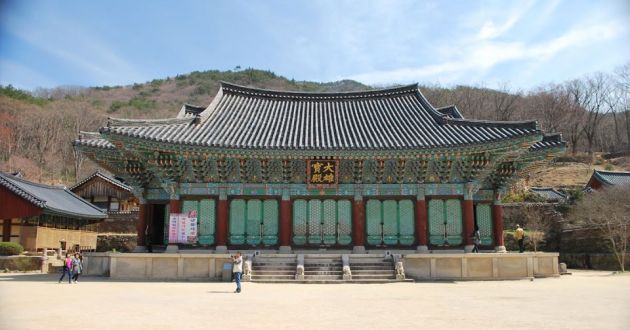
The name, which translates as the “Extensive Pines Temple,” was originally founded as Kilsangsa about 1,200 years prior during the Silla Dynasty. As one of Korea’s “Buddhist jewels,” Songgwangsa temple is one of the primary training centers for Korea’s Jogye Son (zen) sect and has produced 16 national masters, including Master Chinul.
As is too often the case, fire and war have taken their toll on Songgwangsa temple, which underwent six major reconstructions up until the Korean War, when all of the main buildings were destroyed.
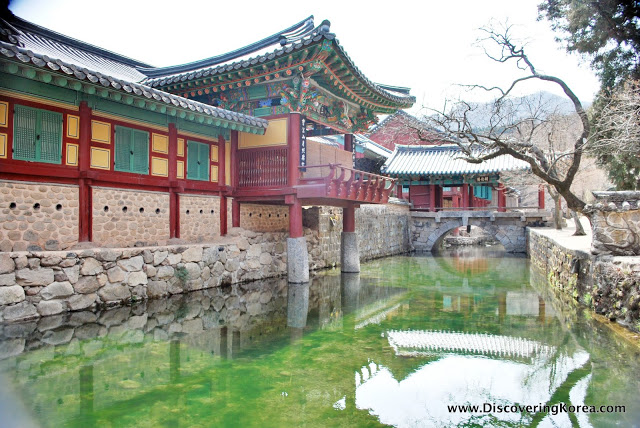
A partial renovation was completed in 1983, and today about 52 major structures dot the Songgwangsa temple campus.
Songgwangsa temple is located on the northwest slope of Jogyesa mountain (조계사). The temple’s architecture complements its surroundings. An arched stone bridge with pavilion spans a formal moat while one building juts out over the water.
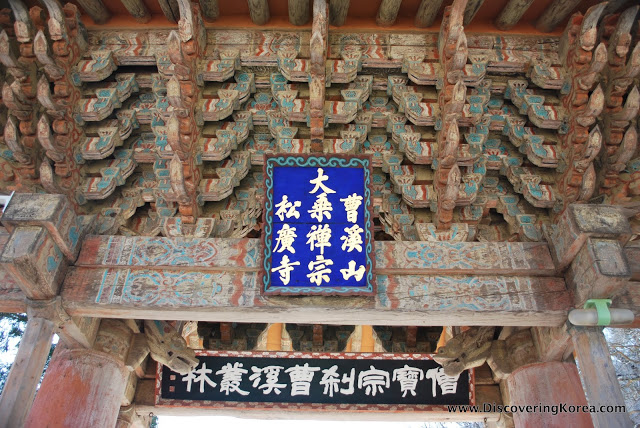
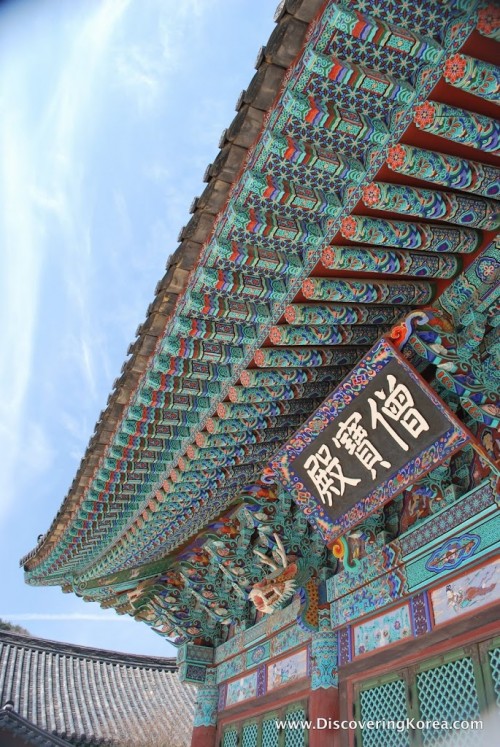
Beautiful royal blue boards with shiny gold paint proclaim each building’s name, while some gates’ ornate roofs are spectacular, yet appear disproportionately large.
Inside the Main Buddha Hall (송광사 대웅보전) are three Buddhas that represent the three states of existence – past, present and future. Four Bodhisattvas are located on either side of each Buddha.
Songgwangsa temple‘s Main Hall’s two-layered roof-line is an attractive architectural element I don’t recall seeing on other Korean temples.
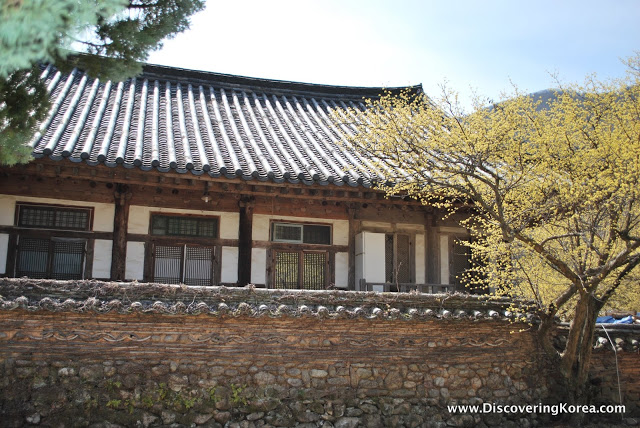
As mentioned previously, some 16 national masters studied at Songgwangsa temple‘s “Sangha Jewel Monastery.”
The first of them, National Master Chinul had a stone stupa erected in his honor in the year 1213. A steep staircase leads up to the sculpture. From there, a nice view of the temple complex can be enjoyed.
Beyond the serene setting, attractive layout and brilliant paint, Songgwangsa temple is the site of some very traditional toilets. An attractive building set upon an attractive pond has two rows of wooden chambers inside.
Although spotlessly clean, there’s a conspicuous lack of toilets, despite the universal restroom signs. And then you look down and see the large rectangle gap in the floor, where one’s waste falls into the pond below.
Leading to the temple, are a large number of restaurants located in large, two-story buildings with traditional tile roofs. There’s also an intriguing hotel on site for adventurous overnight guests.
For Your Information…
| Open: | Generally open sunrise to sunset |
| Admission Price: | 3,000 (Adults); 2,500 (Students) |
| Address: | South Jeolla Province Suncheon-si Songgwang-myeon Songgwangsaan-gil 100 |
| Directions: | From Gwangju Bus Terminal, take a direct bus to Songgwangsa Temple (1.5 hours). Or, from Suncheon Station, take a city express bus #111 to Songgwangsa Temple (1 hour 20 mins.) |
| Phone: | 061-1330 |
| Website: | Official Site |
About Matt Kelley
Matt Kelly is native of the US Pacific Northwest and is half-Korean by ethnicity. He lived in Korea for five years and has written hundreds of travel guides for Wallpaper, TimeOut, the Boston Globe and Seoul Magazine and was a host for several different variety shows on Korean radio and television.