Many may assume that Korea is a tea-based culture. Indeed, Korea has an indigenous tea culture that goes back centuries. But ever since King Gojong became the nation’s first and best-known coffee lover in the late 1800’s, coffee has taken the nation by storm.
More recently, the wildly popular TV drama, “Coffee Prince” captured Korea’s love of java. Today, global giant Starbucks competes with local brands like Holly’s, Ediya and Café Pascucci. But while you can get a decent cup of joe at any of these places, paying 5,000-won or more is a small extravagance. So, why not enjoy your bitter brew at one of Seoul’s best cafés?
Design seems to be a passion of Seoul Mayor Oh Se-hoon. At the very least, he’s put an emphasis on improving the city’s aesthetics, from restricting the unsightly signage that clutters up the sides of many buildings to commissioning a top architect like Zaha Hadid to create a 400-billion won Dongdaemun Design Park and Plaza.
The latter was to coincide with Seoul being named the 2010 World Design Capital, but as such huge projects tend to go, the 83,000-cubic meter plaza is now set to be completed in 2011. So in the meantime, Seoul City officials have sought to build public interest and enthusiasm for good design through the Seoul Design Olympiad.
Although I’m completely unqualified to do so, here’s a quick Korean language lesson.
The word “san” (산) in Korean more or less means mountain. That’s why every mountain in Korea has the “-san” suffix, e.g. Seoraksan, Bukhansan, Jirisan, etc. Trouble is, living here I’ve become familiar calling Korea’s peaks by their Korean names (fancy that!), so calling Jirisan “Mount Jiri” just doesn’t feel right. When translating to English, however, it’s unclear that it’s a mountain without the obligatory “Mt.” title. So what’s my awkward compromise? Mount (Mountain Name)-mountain… something tells me my opinion on this will change shortly.
Anyhow, given that autumn color has started here in Seoul, I wanted to put up some photos from a quick trip last year to, ahem, Mt. Gwanaksan (관악산), located in Southern Seoul.
Here’s a new video blog about the Cheonggyecheon (청계천), perhaps Seoul’s best-known urban renewal project. To read the original post with photos, go here.
The onset of autumn each year in Seoul often means an uncharacteristic calm and quiet in the city. No, it’s not that over 10 million residents decide to slow down to watch the leaves change. It’s because late September or early October marks Chuseok (추석), Korea’s annual thanksgiving holiday that’s among the most important dates on the Korean calendar.
As a modern city, Seoul has adopted many of the conveniences of our globalized society. So, today, it’s commonplace to see familiar global brands, foreign fast-food chains and the fusion of eastern and western styles and cultures.
Of course, these adaptations are convenient for many of us, yet they often lack the specific Korean cultural flavor that makes living in Seoul a special and unique experience. Luckily, truly Seoul-specific places do remain in the city, and in my experience, some of the best ones are the traditional markets. Among them, my favorite is the Jungang, or Central Market (중앙시장), located near the city’s Great East Gate, better known as Dongdaemun.
I’m getting very excited for the annual danpoong (단풍) or autumn leaves here in Korea. And, thanks to an anonymous commenter, now we have the 2009 “color predication” chart for South Korea (I’ll admit the term is a new one for me).
Anyhow, thanks to David Hasenick’s site and I hope this helps folks plan their autumn trips… I’ve got plans to visit Naejang Mountain, Seorak Mountain, Jusanji and Gyeongju… just hope they all pan out!
I’m always surprised by how quickly a metropolis like Seoul can transform into bucolic countryside, thanks to the city’s efficient rail network. In under an hour and for less than two dollars, one can step out of the hustle of Seoul and into rural Korea.
One of the best places within easy reach is Yangsuri (양수리). Located in Gyeonggi Province’s picturesque Yangseo Township, Seoulites know Yangsuri as a convenient and romantic getaway — the perfect place for a day-trip or weekend escape. Located at the confluence of the north and south forks of the Han River, the island-like Yangsuri is the kind of place that can put an urbanite back in sync with nature..
For over 20 years, the curved pink glass tower known as the 63 or yooksamBuilding (육삼빌딩) has stood on the eastern tip of Yeouido Island. Beyond its beauty, the iconic home of the Daehan Insurance Company was Asia’s tallest skyscraper when it was completed in 1985. As a testament to the skyward race since then, today the tower’s 249 meters don’t even break the world’s top 100 list..
Deep in South Jeolla Province is one of Korean Buddhism’s three most important temples, Songgwangsa (송광사). The name, which translates as the “Extensive Pines Temple,” was originally founded as Kilsangsa about 1,200 years prior during the Silla Dynasty. As one of the nation’s “Buddhist jewels,” Songgwang Temple is one of the main training centers for Korea’s Jogye Son (zen) sect and has produced 16 national masters, including Master Chinul.
I’m in the process of migrating DiscoveringKorea.com to a more flexible blogging software… It will take a few days to re-work the design and fix technical kinks. Afterward, I expect to introduce some great new features.
In 2002, Korea and Japan welcomed the world as joint hosts of the World Cup football tournament. Soccer stadiums were erected all across Korea. Seoul’s World Cup venue was placed at the city’s far western end in a place that many people probably wouldn’t have selected just a few years earlier.
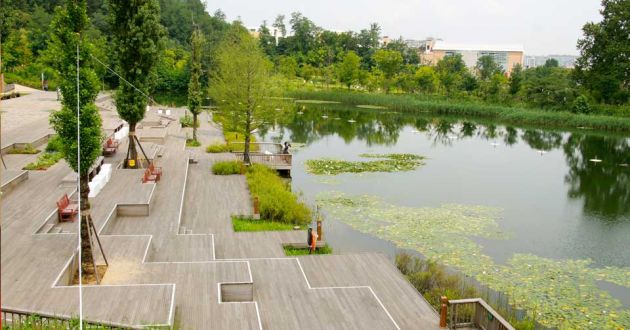
That’s because World Cup Stadium is located next to the Nanjido Landfill, a massive disposal site that operated until 1993. Like any metropolis, Seoul produces millions of tons of garbage, and Nanjido was the nation’s largest uncontrolled landfill. But what may sound like an inauspicious place was transformed into a pretty spectacular one when nature was encouraged to reclaim the land.
Summer may be peak festival season in Korea, but I much prefer traveling during the autumn months, when the temps fall, the leaves turn and the crowds are a little less crazy. What follows are some of Korea’s best autumn festivals. Also be sure to check out the Korea Tourism Organization’s great new interactive festival website (Go here and then look for the festivals icon on the right side).
During Seoul’s hot, late summer weeks, if you’re walking along the colorful streets of the Hongik University neighborhood, you may very well happen upon a seemingly impromptu performance. That’s because for the past 12 years, Seoul has hosted perhaps Asia’s largest Fringe Festival, a three-week showcase of independent and underground art installations.
During the summer, Korea’s national flower, the mugungwha (무궁화) or Rose of Sharon, is in bloom across the city. And each year, August 15th is celebrated as Gwangbokjeol (광복절), or Korean Independence Day. But before Korea’s liberation, millions of Koreans participated in activities to free themselves from Japan’s brutal colonialism. And perhaps the most important site in that struggle is Tapgol Park (탑골공원), in central Seoul’s Jongno District.
Some of the Discovering Korea blog’s recent visitors came here by way of TBS eFM 101.3, and here’s why. Starting this past Saturday, I’m hosting a new travel segment on the Saturday edition of The Steve Hatherly Show, produced by Jin Min.
Just like my other Korea-related travel and culture shows, each week I’ll describe a new destination in Korea. But what’s different is the show’s conversational format. Originally from Canada, Steve has lived in Korea over nine years, and so far it’s been fun to talk with him on the radio about travel opportunities on this beautiful peninsula. Just like my KBS shows, I’ll cross-post content to this blog.
If you’d like to listen to my new show and you’re located in the greater Seoul area, tune into TBS eFM 101.3 MHz on Saturdays, between 14:05-16:00. The show is also available in Busan, Gwangju and elsewhere in Korea. PC-users can listen via TBS’s TOY Internet Radio – a free download is available on their site.
Finally, I’d like to incorporate listener tips and questions, so I hope you’ll send them my way. Have a great week!
August 15th is Gwangbokjeol (광복절) or Korean Independence Day, which celebrates the defeat of the Japanese during WWII and Korea’s liberation after 35 years of oppressive colonial rule.
In honor of the day, let’s head to Cheonan, South Chungcheong Province to visit the Independence Hall of Korea. The extensive complex was opened to the public in 1982, and serves to collect, preserve and display a wealth of data about the Korean civilization, with a special focus on the nation’s early 20th century independence movement against Japan.
On August 1st, 2009 Seoulites welcomed their city’s newest landmark. After 15 months of renovation, Gwanghwamun Plaza (광화문 광장) is now open to the public and is sure to become a major city attraction.
One of the best things about Seoul is its efficient and inexpensive public transit system. It’s a mind-boggling number, but the metro rail system facilitated over two billion passenger rides in 2008. Seoul’s network is the world’s third most heavily used, behind only Tokyo and Moscow.
Today, the massive system consists of 15 lines, with two more to open in the next year. On June 24, 2009, the inaugural journey of Metro Line 9 began at 7:00 am from Gaewha Station (계화역) in western Seoul for its 25.5-kilometer journey to Sinnonhyeon Station (신논현역), in southern Seoul.
I wanted to introduce a new device that I picked up during a quick week spent in the U.S. a couple of weeks ago. So far I’m liking my mino-HD Flip Video camcorder. The picture and sound quality is better than my previous camera, and it’s just easier to use, mostly thanks to its small size and built-in USB.
It’s not all great, however. Things get awfully blurry while panning and the zoom button can be awkward to push. Also, when editing it’s been more difficult to stabilize the video… but overall, so far so good. Now I just need to learn how to use a tripod! I’m looking forward to hearing what you think of future videos. If you have other toys to suggest, I’d like to hear about them.