
Last year, my friends Do-hoon and KBS World’s Abby Rhodes took three days to explore Korea’s Donghae, or East Sea. During our three-day exploration of Gangwon province, on day 1 we explored the mountains, and on day 2 we decided to take a Gangwon Province day at the beach.
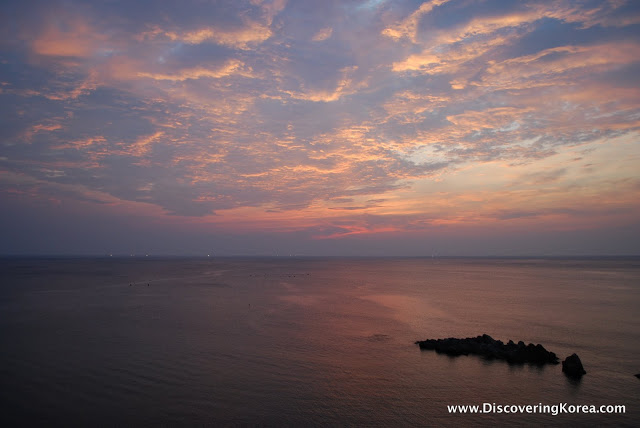
Of course, Korea’s east coast is the first place to see the sun rise here, and many Koreans visit it to make a wish on special days like the lunar New Year. Although our special wish for no rain was already granted, we awoke at 4 am anyhow to see the sun rise at Naksansa temple (낙산사).
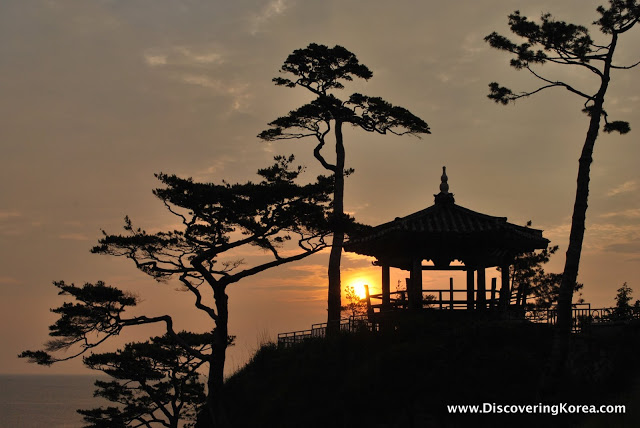
Located on a bluff overlooking the East Sea, Naksansa temple was one of the country’s most beautiful Buddhist temples until a 2005 fire destroyed most of the wooden structures and a 15th century bronze bell.
However, restoration is underway, and the temple’s pavilion remains a tranquil spot to wait for spectacular views of first sunlight.
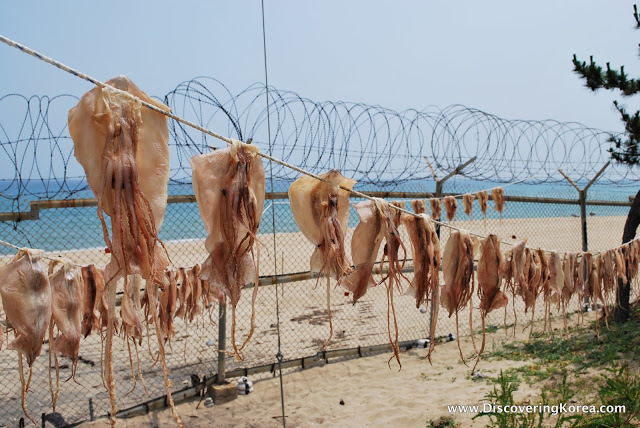
Now, it’s Gangwon province’s tranquility that makes it a refreshing contrast from hectic Seoul. But the province also bears vivid reminders of the Korean War. It was cut in half when the peninsula was partitioned in 1953, and the barbed wire fences along its beaches remain to keep North Korean spies out.
f it sounds scary, it isn’t, really. Hanging from the fences are also lines of drying squid that sway lazily in the breeze with untarnished white sand beaches stretching behind them. In fact, there are 100 bathing beaches in Gangwon province, so many, in fact, that many of them remain unnamed.
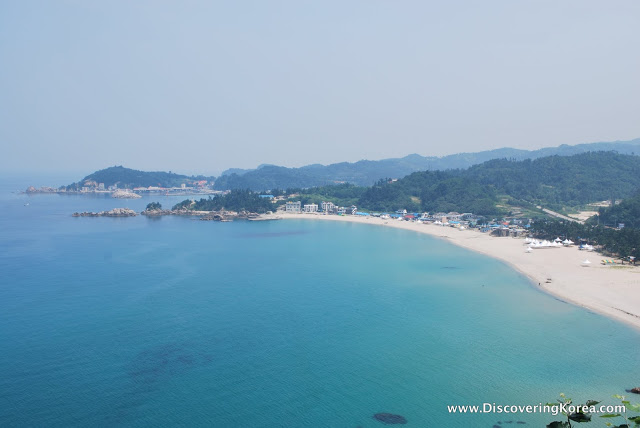
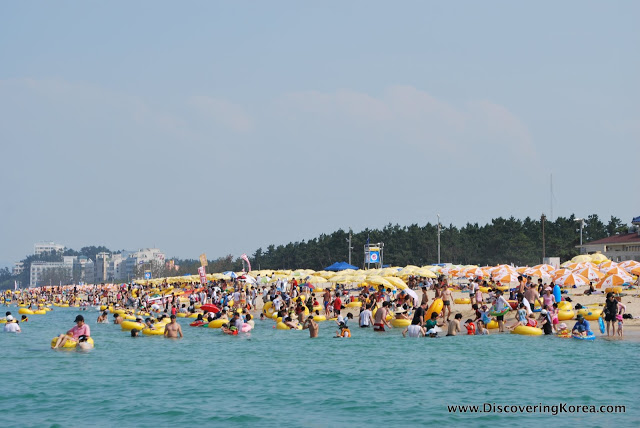
But to truly kick off our Gangwon Province day at the beach, our first stop was popular Sokcho Beach, a hot spot named after the town whose claim to fame is being just 30 minutes from Seoraksan mountain.
Hundreds of beachgoers were enjoying the coarse sand and cool water. Now, whereas most North Americans and Europeans worship the sun, most Koreans do their best to hide from it.
On the beach, couples and families played underneath huge umbrellas and other sun-blocking contraptions.
A couple of hours later, we brushed off the sand and took a short drive down to the Illhyun Museum’s “Sky’s the Limit” observatory. The striking and modern, 7-story-tall steel edifice was designed by French artist Didier Fiuza Faustino, and offers panoramic views of Dongho Beach.
The top decks are side-by-side rectangles, whose walls alternate between steel grating, glass and open air. The painted white steel against the sea and sky made everything look a cool, faint blue.
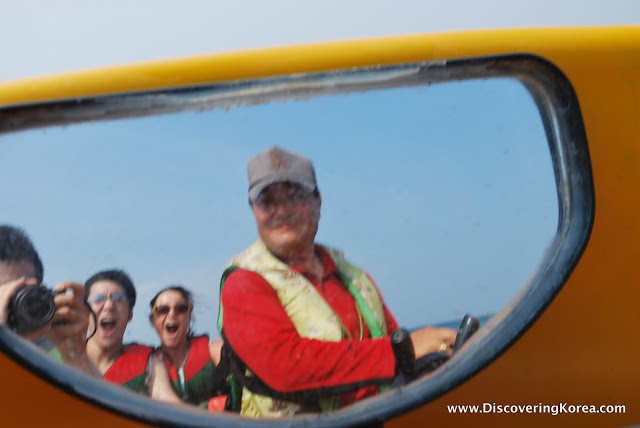
Sight seen, it was back to the beach! This time to Gangneung’s Gyeongpo Beach. A buffer of windswept pine trees and a boardwalk separated the street from a soft sand beach popular with youngsters.
While they ate ice cream, were pulled on inflatable sea biscuits, and even bungee jumped, Abby, Do-hoon and I hopped into perhaps the world’s smallest speedboat for a fun rip along the coast.
But by then the sun had long past its zenith.
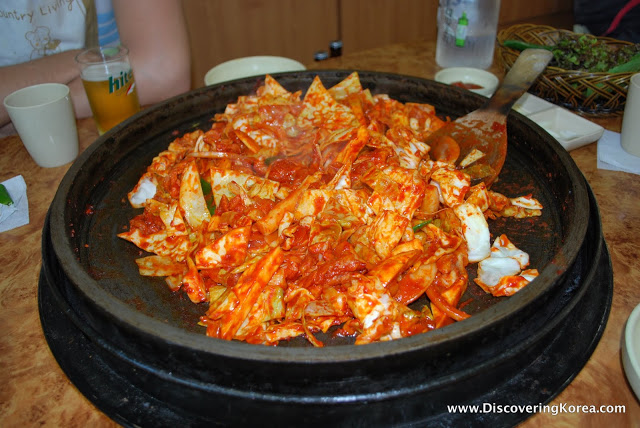
And, sadly, day 2 was Abby’s last one with us, so before she boarded the bus back to Seoul, we found a family restaurant that specialized in Gangwon province’s famous Chuncheon ddak-kalbi (춘천 닭갈비), a sweet and spicy marinated chicken that’s fried on your tabletop with cabbage, onions and rice cakes. It was a delicious end to our Gangwon Province day at the beach.
For Your Information..
| Open: | Naksansa temple: Typically sunrise to sunset Beaches: 06:00-24:00 |
| Admission Price: | Free |
| Address: | Gangwon-do province |
| Directions: | For Naksansa, from Sokcho Express Bus Terminal, take bus #9 or 9-1 to Naksansa temple.For Gyeongpo Beach, from Gangneung Intercity Bus Terminal, take bus #202 to Gyeongpodae. For Sokcho Beach, take a bus from Dong Seoul Bus Terminal (near Gangbyeon Station) to Sokcho |
| Phone: | 033-1330 |
| Website: |
About Matt Kelley
Matt Kelly is native of the US Pacific Northwest and is half-Korean by ethnicity. He lived in Korea for five years and has written hundreds of travel guides for Wallpaper, TimeOut, the Boston Globe and Seoul Magazine and was a host for several different variety shows on Korean radio and television.