
The Seoul Arts Center (예술의 전당) is located on the city’s southern border in Seocho District. Set against a verdant backdrop of a forested hillside, the huge complex opened in 1993 and is dedicated to Korean arts and culture.
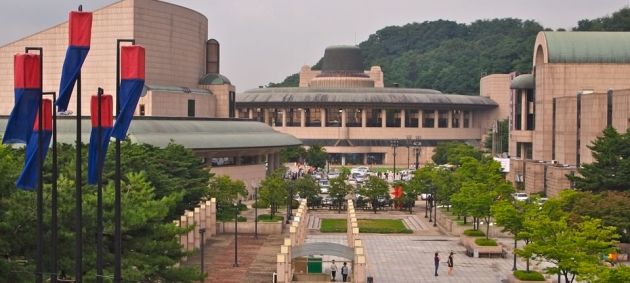
Each year, the Center hosts more than 1,400 performances and 100 exhibitions in seven large venues. It’s a popular place in the city, with some two million visitors annually.
I’ve been to the Seoul Arts Center on a few occasions, usually to watch a pansori Korean folk opera performance or to see a special exhibit.
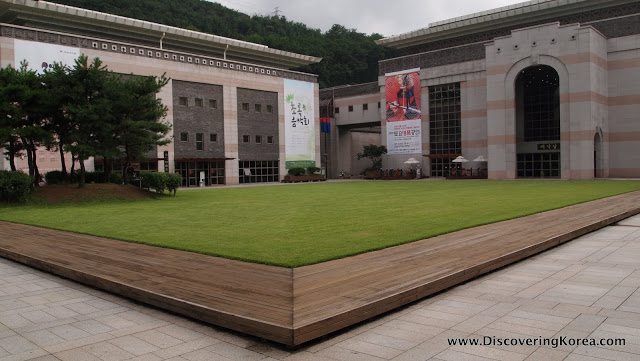
On my latest visit it was for the latter, a unique opportunity to view Pulitzer Prize-winning photographs from the past 60-some years.
The sprawling arts campus centers around a plaza that connects the Opera House and the Hangaram Art and Design museums.
The plaza is a pleasant space, with chairs and parasols set around a large stretch of green astro-turf. Several black wire sculptures resembling trees and human bodies appear on the ground or atop a roof.
In front of you is the urban jungle, and to the back a natural forest.
Below your feet is the curiously named Vitamin Station.
Named for the vital nutrients arts and culture can provide, the space includes a large waiting area, a small exhibition space, an information and service area, not to mention a cool respite from the summer heat!
It’s also where street level foot traffic most easily accesses the complex.
Most of the Seoul Arts Center’s buildings were constructed in the 1980s and 90s. But despite their modern appearance, several were built with traditional Korean motifs in mind.
For example, the cylindrical Opera House was designed with the “gat” or traditional Korean man’s hat from the Joseon Dynasty in mind. Similarly, from above, the roof of the Music Hall resembles a Korean fan.
And if you take a close look under the eaves of several buildings, you’ll no doubt see layered patterns from traditional Korean wood structures, from temples and palaces to hanok-styled homes.
Two flights of stairs up from the main plaza is the Music Plaza. In addition to the large World Music Fountain and potted trees are the Music Hall, the Korea National University of Arts and the Seoul Calligraphy Museum.
The latter is said to be the world’s largest exhibition center for calligraphy. Venture even further west to a trio of imposing buildings that surround a real lawn.
Although the campus for traditional Korean music is not officially part of the Seoul Arts Center, they, too are dedicated to the fine arts.
One point of note is that the Seoul Arts Center is awfully busy on the weekends.
The wait times for special exhibits can easily exceed one hour, so many of the patient patrons pass the time in a great gift shop located in the Hangaram Art Museum, whose fine art frames, furniture, jewelry and books are surprisingly affordable.
And since this is Seoul, there is no shortage of cafés on the Seoul Arts Center’s grounds. In addition to five basic coffee shops are three cafés that also serve food. There’s also the buffet restaurant Train Bleu.
For Your Information…
| Open: | Depends on performances |
| Price: | Depends on performances |
| Address: | Seoul Seocho-gu Seocho-dong 700 |
| Directions: | Seocho Station (#224) on Line 2, Exit 3; Nambu Bus Terminal (#341) on Line 3, Exit 5. Green: 4429 or Maeul 12 from Exit 5 of Nambu Bus Terminal Station |
| Phone: | 02-580-1300 |
| Website: | Official Website |

About Matt Kelley
Matt Kelly is native of the US Pacific Northwest and is half-Korean by ethnicity. He lived in Korea for five years and has written hundreds of travel guides for Wallpaper, TimeOut, the Boston Globe and Seoul Magazine and was a host for several different variety shows on Korean radio and television.