
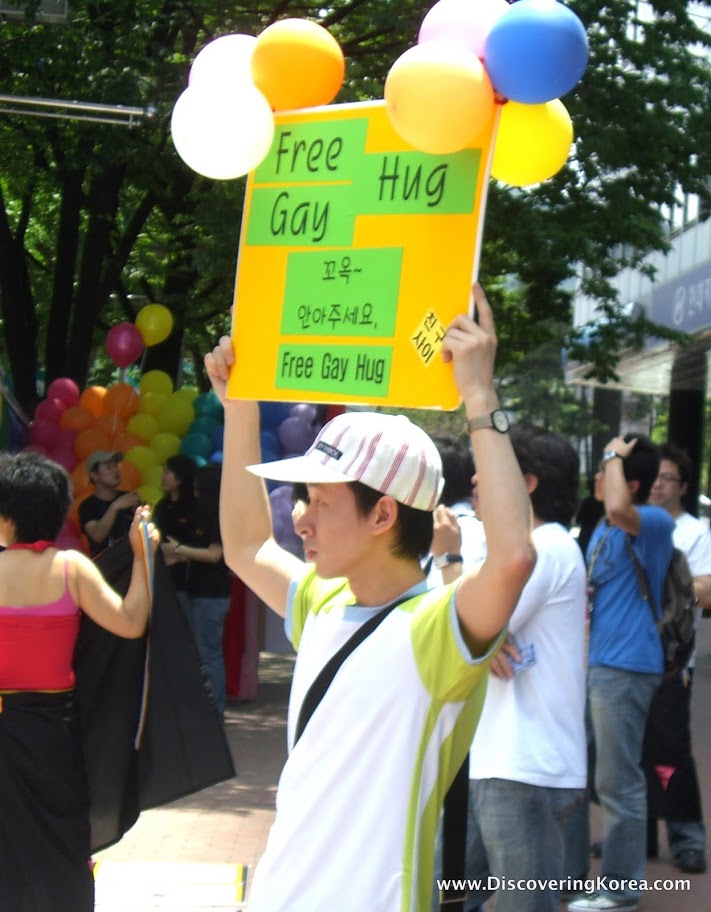
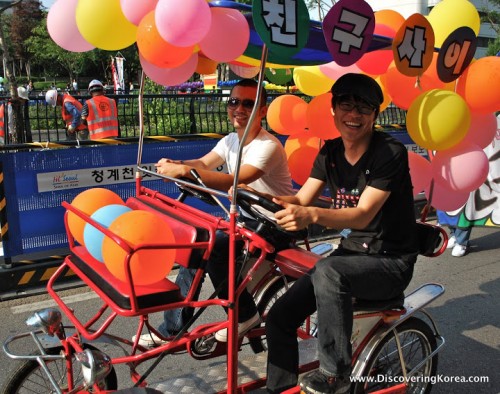
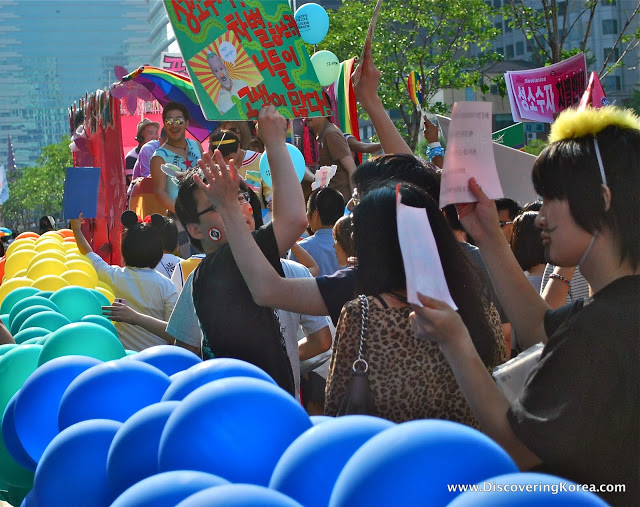
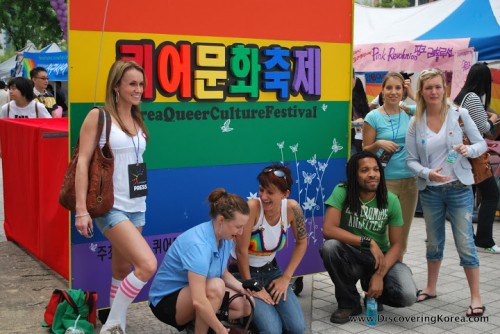
On Saturday, an estimated 1,500 people marched along the Cheonggyecheon stream (청계천) in downtown Seoul. The main event of the 10th annual Korea Queer Culture Festival (KQCF) marked South Korea’s largest-ever celebration of homosexuality.
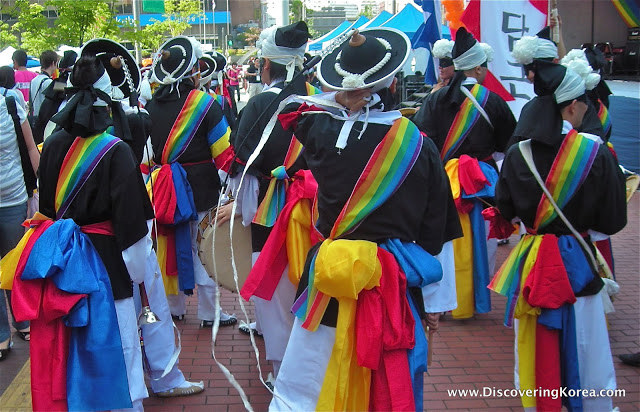
The procession was led by a troupe of pungmul folk musicians and three trucks outfitted with rainbow flags, dance platforms and speakers playing Korean pop.
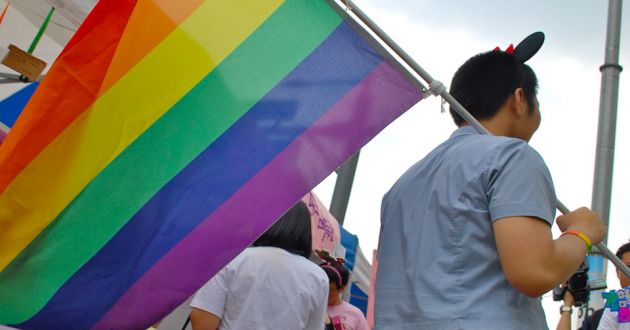
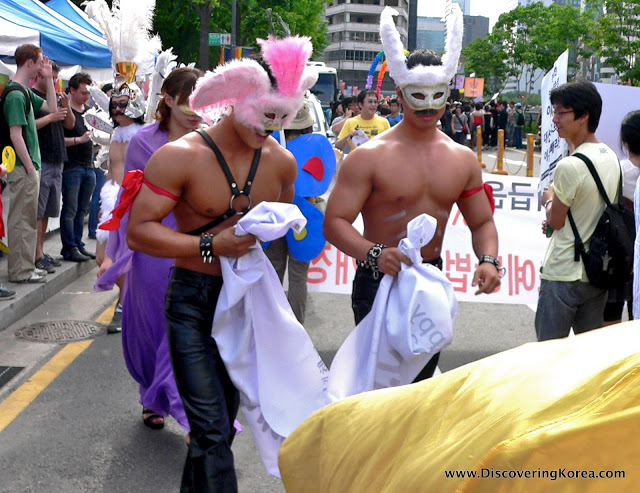
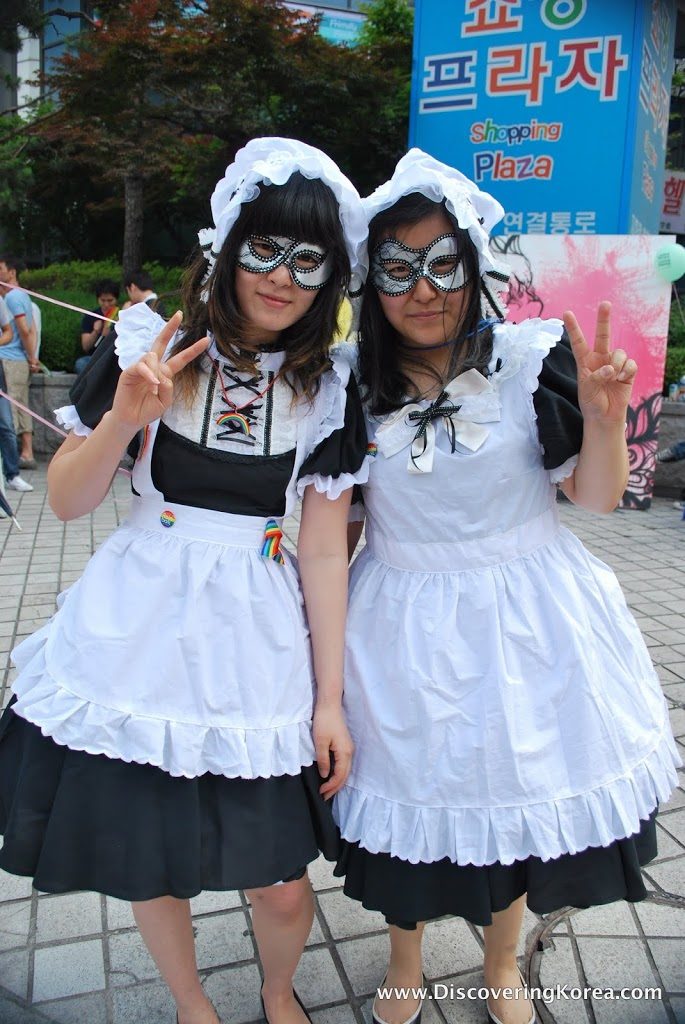
Locals wearing “God made Queer” buttons marched with foreign English teachers and teen boys donning mouse ears and pleated skirts.
The 15-day event kicked off on May 30 with a photo exhibition and an event organized by the queer youth group, Rateen.
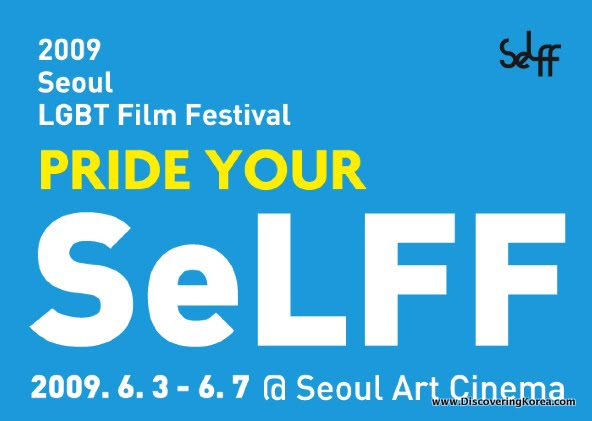
From June 3-7, the Seoul LGBT Film Festival (SeLFF) screened 29 feature films, documentaries and short films at the Seoul Art Cinema. Following Saturday’s parade, an after party at Club Pulse in Itaewon lasted well into Sunday morning.
The 15-day event kicked off on May 30 with a photo exhibition and an event organized by the queer youth group, Rateen.
From June 3-7, the Seoul LGBT Film Festival (SeLFF) screened 29 feature films, documentaries and short films at the Seoul Art Cinema. Following Saturday’s parade, an after party at Club Pulse in Itaewon lasted well into Sunday morning.
Queer pioneers
In the years following Japanese occupation and civil war, military dictatorships suppressed social organising across South Korea.
Although tiny bars in Seoul’s Jongno neighborhood have catered to gay clients for decades, it wasn’t until 1993 that the country’s first queer rights group, Chodonghwae, was founded.
Two years later, the first campus group, Come Together, formed at Yonsei University (연세대학교).
According to Jun Dong-beom (전동범), the 2009 SeLFF Programmer, members of those early groups were inspired by events abroad. “In the early 1990s there were some [LGBT organizations] at Korean universities and they saw there were many pride parades and festivals in other countries.
So at the time the college students and some gay and lesbian activists started planning to have our own parade.”
In 1997, Come Together founder, Seo Dong-jin (서동진), organised what was to be South Korea’s first queer film festival. But on opening day, local government officials cut off the theatre’s electricity and threatened organizers with fines and lengthy jail sentences.
Despite attempts to thwart the festival again in 1998, in November, the first Seoul Queer Film and Video Festival was convened at the Artsonje Center.
Jun, who helped organise the inaugural festival, says that despite a positive reception, the event bankrupted the group. In 2000, the first Korea Queer Culture Festival, a two-day event called “Mujigae (Rainbow) 2000″ was established by merging a film festival with a parade and dance party.
At that first-ever march, 50 people walked through Seoul’s Daehangno neighborhood.
Express your-SeLFF
Something probably unthinkable in 2000 was that in less than ten years, Choi Hyun-sook (최현숙) would become South Korea’s first openly lesbian candidate for National Assembly.
Choi, 52, who was among the marchers on Saturday, is the subject of, The Time of Our Lives, a film documenting her unsuccessful 2008 election campaign.
Directed by Hong Ji-yoo and Han Yeong-hee, the film was among 29 screened during the five-day Seoul LGBT Film Festival (SeLFF), Korea’s only queer film festival.
Other screenings featured Le Nouveau Monde (The New World), a quirky movie about lesbian motherhood in the Paris suburbs, and Takumi-kun: June Pride, a humorous adaptation of a novel by Shinobu Gotoh.
Despite a decade of pride festivals on the Korean Peninsula, only a handful of Korea’s queers participate in events like the SeLFF and the Korea Queer Culture Festival parade.
And even among those who did last weekend, a desire to stay firmly in the closet was visible on many faces – literally. About half of the people perusing the festival’s information booths wore stickers of a camera inside a red slashed circle on their cheeks or chests.
Media had to sign a form promising to refrain from photographing marked individuals.
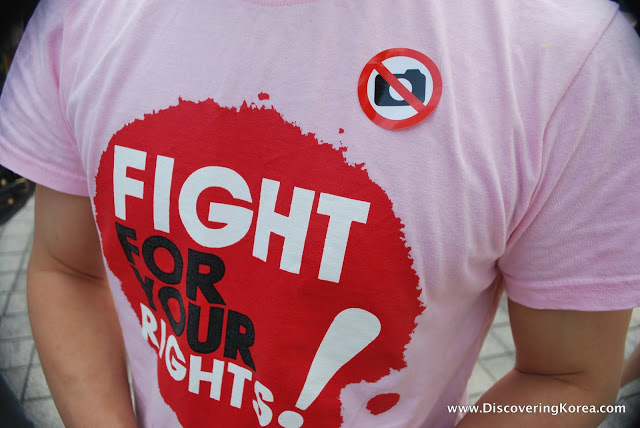
Insisting that one’s attendance not be documented at a “pride” event was an irony that didn’t escape Brian, an American English teacher living in Seoul.
“I’m torn because you’re at a gay pride parade, so the whole point is to be visible…, but on the other hand there are repercussions and they could lose family members… so I understand, but it’s sad it has to be this way.”
He added, “…In the end they’re here and they want to be here… Maybe one day they don’t have to wear those stickers.”
Korea’s Rainbow Teens
For members of the queer youth group, Rateen (Rainbow Teen), that day may have already arrived. As part of the pre-parade entertainment, the crowd cheered as eight youngsters in white oxford shirts, blank pants and ties performed a racy dance on stage.
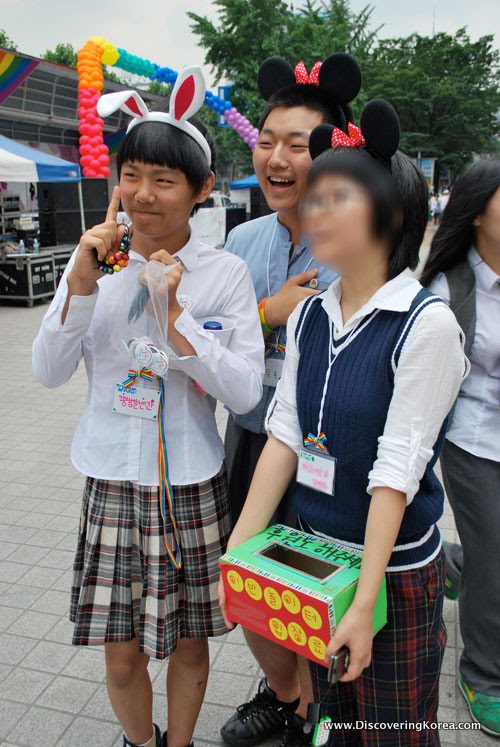
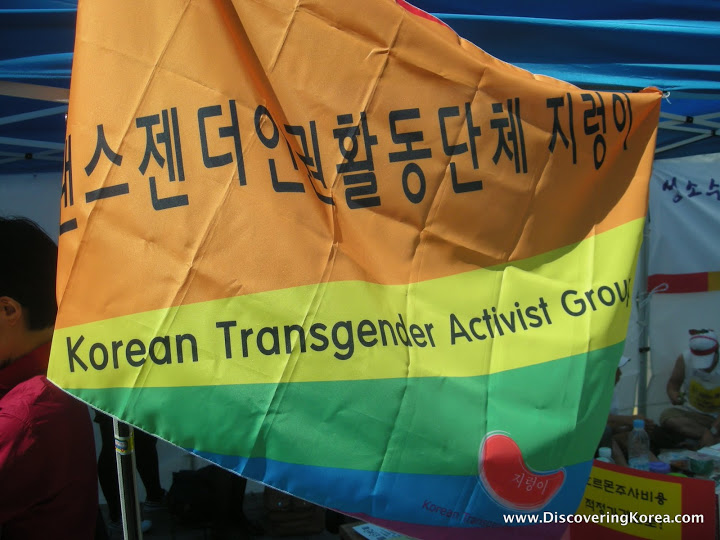
Founded in January 2007 by two teens who go by the nicknames “Chingy” and “Roosky,” Rateen encourages Korean teens to come out of the closet through informal peer counseling.
Although the 2,000-member organization is focused on LGBT youth, 17-year-old Roosky Lee says that anyone interested in learning about queer youth culture can join.
In fact, Lee says his group helps older Koreans who came of age in a less open era. “[A] lot of Koreans just believe that gays don’t exist in Korea, so many of the people, even though they are gay, they really don’t know about their sexual identity.”
Describing a “really old” 49-year-old man who left a meeting thinking he might be gay, Lee adds, “… sometimes through our community [older people] just come and they start to realize their sexual identities. So I think we’ve kind of helped them.”
Although he co-founded a group that encourages Koreans to come out of the closet, Lee isn’t out to his parents yet. “I really wanted to say that I’m gay to my parents but then they just don’t seem to understand what I’m saying,” he says.
Although his parents are proud of him for co-founding Rateen, a fact he freely shared with them, he thinks they interpret “supporting sexual minorities” to mean that he doesn’t have sex.
In September, Lee will start college in the San Francisco Bay Area, where he looks forward to a more open LGBT community where he hopes to find a boyfriend.
In the meantime, he says he needs to be “more courageous” and plans to come out to his parents “very soon.”
Is the party over?
An Asia representative of the International Lesbian and Gay Association (ILGA) who asked to be identified only by his nickname “Joong,” said he was impressed by this year’s Korea Queer Culture Festival.
A native of Mongolia, he has been to many pride events around the world and was surprised by the reception of non-queer Koreans. “Korea is a conservative country, but compared with other Asian countries like Iran… Mongolia and China [there’s] not much stigma [against sexual minorities].”
A woman who happened upon the parade with a friend seems to support Joong’s claim. “Actually, I’m very happy to see [a] gay parade here because it seems like Korea is changing, right? It’s global… so I’m happy to see that.”
Despite positive reviews, not everyone is optimistic about the Korea Queer Culture Festival’s future. Describing South Korea’s president, Lee Myung-bak, as “very homophobic,” Han Chae-yoon, who has helped organise the event since its inception, says that funding insecurity and a hostile political environment threaten its feasibility.
In a 2007 interview with a major national newspaper, Lee – who was then a contender in the presidential race – was quoted as saying that he thought homosexuality to be abnormal and the only “normal” union is between a man and woman.
According to SeLFF Programmer Jun, the festival’s 2009 budget was cut by half, from 30 million won in 2008 (about US$24,000) to just 15 million this year.
A long-time and significant source of support is the Korean Film Council (KOFIC), which provided 7 million won for this year’s film series. By the end of June, organizers expect to know what KOFIC will allocate for next year. Jun says the 2010 film festival will be cancelled if the grant falls short.
Although most Korean queers admit that South Korean attitudes about homosexuality have improved considerably over the past ten years, LGBT activists like Han insist that fundamental challenges persist.
“Ten years ago [LGBT Koreans] were afraid to express their sexual identities. Now, the community has grown, yet we still don’t have our rights and we can’t live our lives outside of the closet. These problems remain.”
About Matt Kelley
Matt Kelly is native of the US Pacific Northwest and is half-Korean by ethnicity. He lived in Korea for five years and has written hundreds of travel guides for Wallpaper, TimeOut, the Boston Globe and Seoul Magazine and was a host for several different variety shows on Korean radio and television.